Terrace Farming 101 Terrace farming, or step cultivation, is the method of growing crops on the sides of hills or mountains by planting on graduated terraces built into the slope. Through this type of farming, soil erosion is stopped and helps to conserve soil. Terrace farming was invented by the Inca people who lived in
Terrace Farming 101
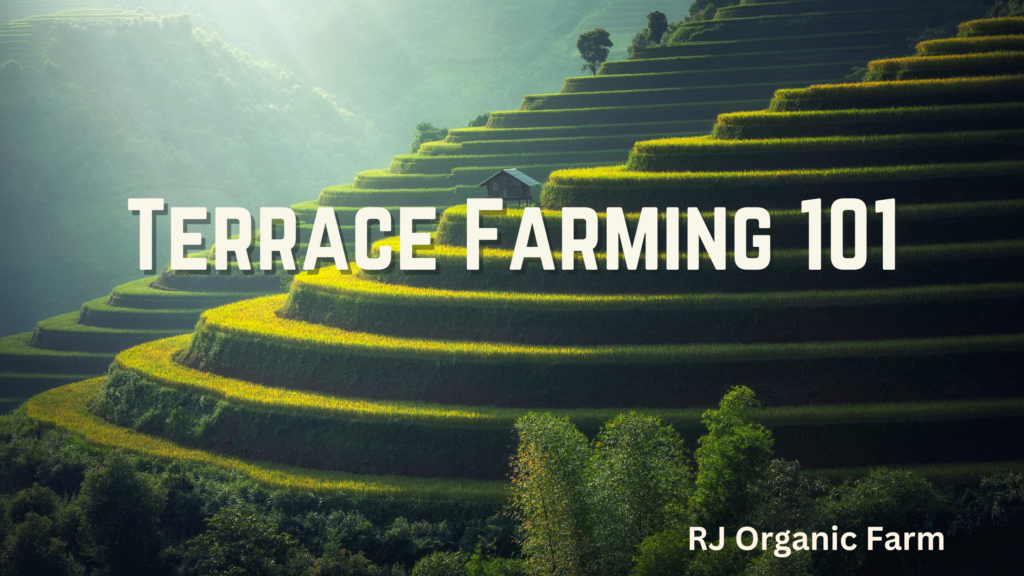
Terrace farming, or step cultivation, is the method of growing crops on the sides of hills or mountains by planting on graduated terraces built into the slope. Through this type of farming, soil erosion is stopped and helps to conserve soil. Terrace farming was invented by the Inca people who lived in the South American mountains. This farming method has made cultivating crops in hilly or mountainous regions possible and it assures the growth of versatile crops. It is one of the best agricultural ideas which helps to earn good productivity.
Types
In farmed areas, agricultural terracing is either level or tilted. They depend on the soil infiltration properties. If soil infiltration is sufficient, they are made level.
The most popular types of terrace cultivation are broad-base, narrow-base and grassed back-slope.
Broad-Base Terrace Farming
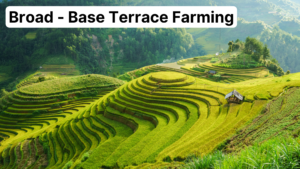
A broad base terrace is a surface channel or embankment type construction, which is formed across the land slope. Broad base terraces may be classified into two types, based on their primary functions, i.e. to retain or remove the runoff water.
Narrow-Base Terrace Farming
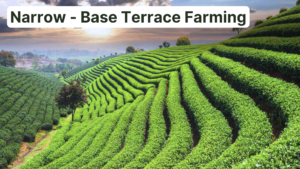
A terrace of this type is another example of perennial terracing, but in this case, permanent vegetation covers both the front and back sides. These parts are not cultivated. Like with the grassed back slope, the earth is usually moved downhill. Yet, this is the steepest terracing type, requiring less amount of earth for platforms than others.
Grassed Back-Slope Terrace Farming
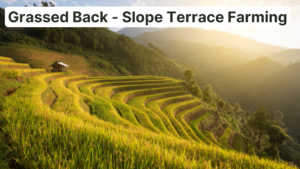
The farming type is an example of perennial terracing. As the name suggests, the back slope cover is perennial grass. In the given terrace farming technique, the back slope is not cultivated, unlike the main part. Typically, the main part includes the soil taken from the downhill upwards, with further levelling for farming.
Advantages of Terrace Farming
Improves permeability and land productivity of sloped pastures.
Contributes to water preservation by slowing down and decreasing water runoffs.
Enhances rainwater harvesting
Prevents soil erosion by decreasing rill formations
Increases soil conservation
Lowers sedimentation and water pollution
Crops Cultivated Through Terrace Farming
The choice of species depends on their productivity in highlands and sensitivity to waterlogging since terraces tend to accumulate moisture. For example, rice grows in paddies, but its productivity drops on elevations higher than 375 m.
In particular, examples of common crops farmed by terrace farming include :
Wheat
Buckwheat
Corn
Rice
Millets
Saffron
Black Cumin
Pulses
Apple
Tea Leaves
Popular Terraces Around The World
Terraces are very useful for many things. They not only help the people to cultivate their crops but they also provide stunning views. Some of the breathtaking terraces are :
Sa Pa Terrace
Sa Pa is a town in northwest Vietnam not far from the Chinese border. The rice terrace fields, among the most popular tourist attractions in Vietnam, can be found in the Muong Hoa valley between Sa Pa town and Fansipan Mountain, on a backdrop of thick bamboo woodlands.
Inca Pisac
The still intact terrace fields of Pisac, constructed by the Incas, are still being used today. These mountainous terraces consist of 16 different cultivation sections. Pisac, a word of Quechua origins, means “partridge”. Inca tradition dictated building cities in the shape of birds and animals, and as such, Pisac is partridge shaped.
Bali Rice Terraces
In central Bali, north of the village of Tegallalang in the Ubud district, lies a series of thriving stepped rice paddies. In Bali, the terraced rice paddies are worked according to a well-organized social order, called a subak. The subak manages the irrigation water sources, on a strict schedule, fairly distributing the water.
Choquequirao
Another Peruvian stepped agricultural site is Choquequirao, meaning Cradle of Gold. Seated on the border of Cuzco and Apurimac, this impressive terraced site is located 3085 meters (10,120 feet) above sea level. Choquequirao contains a staircase configuration, made up of 180 terraces. Built-in a completely different style than Machu Picchu, Choquequirao is much larger in area.
Salinas de Maras
The Salineras de Maras or Inca salt pans have been used for centuries. Salt miners direct natural spring water, containing high concentrations of salt, into the man-made terraced flats, numbering around 3,000. This spring water becomes saline by leeching salt from the mountain itself. When the water is evaporated by the sun, thick salt deposits remain. The salt is then cut into huge slabs and transported to the markets.
Longji Terraces
The Longji or Dragon’s Backbone rice terraces were built over 500 years ago during the Ming Dynasty. The terrace fields are found in Longsheng about a two hours drive from Guilin. From a distance, during the growing season, these winding terraces appear as if they were green woven cables laid out over the hillsides, starting at the riverbank and ending near the mountaintop.
Hani Terraces
The Hani rice paddy steppes are located below the villages on the side of the Ailao Mountains in Yuanyang and have been cultivated for over 1,000 years. Also carved by hand by the Hani people, these rice terraces have turned a barren hillside into a lush sub-tropical paradise.
Banaue Rice Terraces
Situated in the heartlands of the Cordilleras mountains of the Philippines and rising to an altitude of 1525 meters (5000 ft) are the Banaue Rice Terraces. The terraced fields were carved out by hand without modern tools by the Ifugao tribes and have been producing rice for almost 2,000 years.
Machu Picchu
One of the most beautiful and impressive ancient sites in the world, Machu Picchu was rediscovered in 1911 by Hawaiian historian Hiram Bingham after it lay hidden for centuries above the Urubamba Valley in Peru. The “Lost City of the Incas” is invisible from below and completely self-contained, surrounded by agricultural terraces and watered by natural springs.